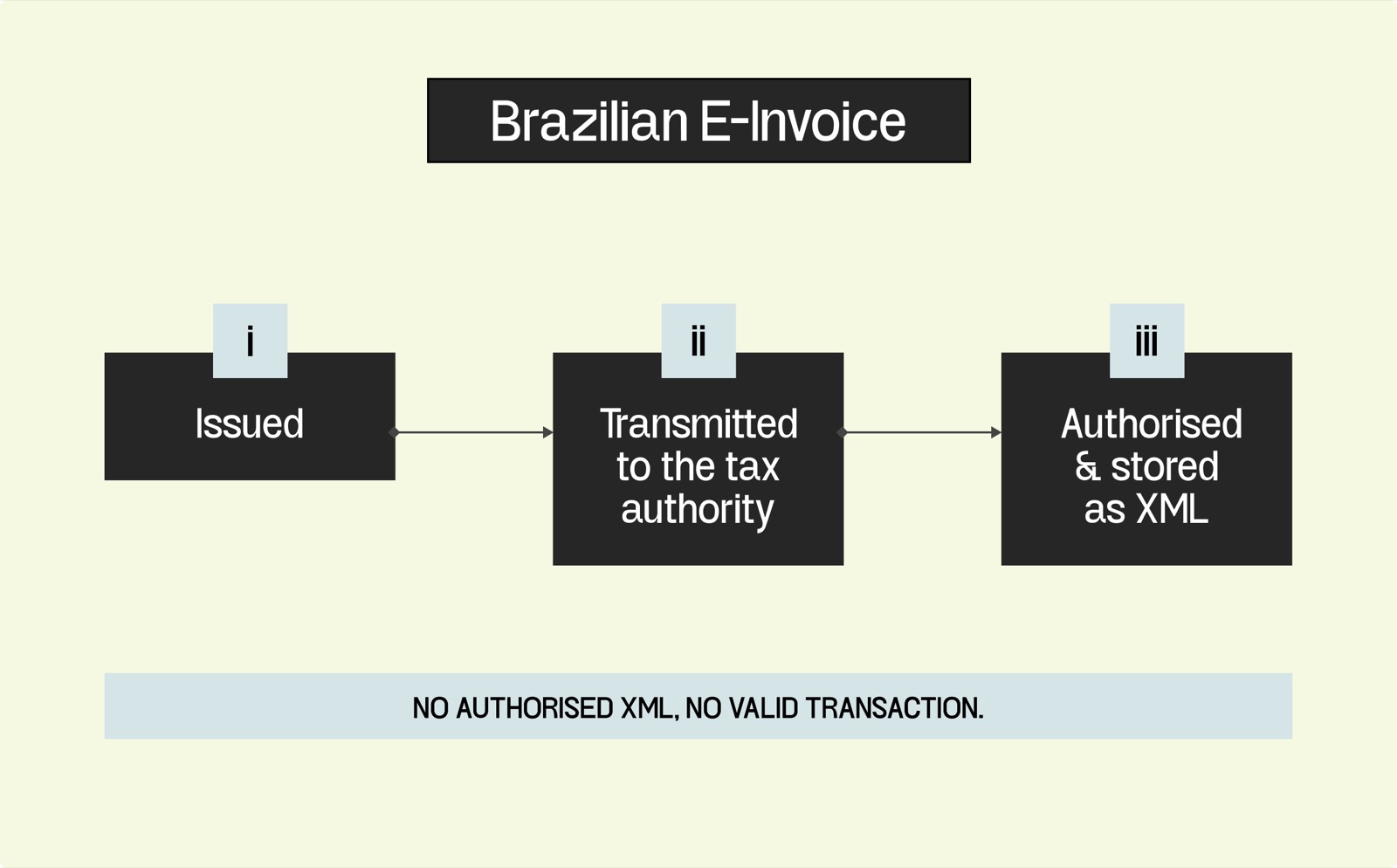
In Brazil, an invoice isn’t paperwork. It’s permission. Every service or product transaction must be issued, transmitted, and stored as an XML document, authorised by the tax authority before the sale is legally valid. No authorised XML, no valid transaction. It’s the most instrumented fiscal system in the world, and it watches every BRL in real time.
For foreign companies, there’s been a loophole-shaped comfort zone: sell digital services into Brazil from abroad and none of it applies to you. A simple receipt does the job. On 1 January 2027, that comfort zone closes. Under Brazil’s tax reform, foreign digital sellers must register, collect the new federal VAT at the point of sale, and report it to Receita Federal. Here’s e-invoicing from first principles, and what the reform actually changes.
In short: Brazil requires a government-authorised e-invoice for every transaction: NFS-e for services, NFCom for telecom, and NF-e for physical products. Foreign companies selling digital services from abroad are outside this system today. From 2027, under tax reform LC 214/2025, they must register for CBS (the new federal VAT) and collect it at checkout. The old taxes (PIS, COFINS, ICMS, ISS) phase out through a 2026–2032 transition. Winners get their payments and tax setup right before the deadline instead of scrambling after it.
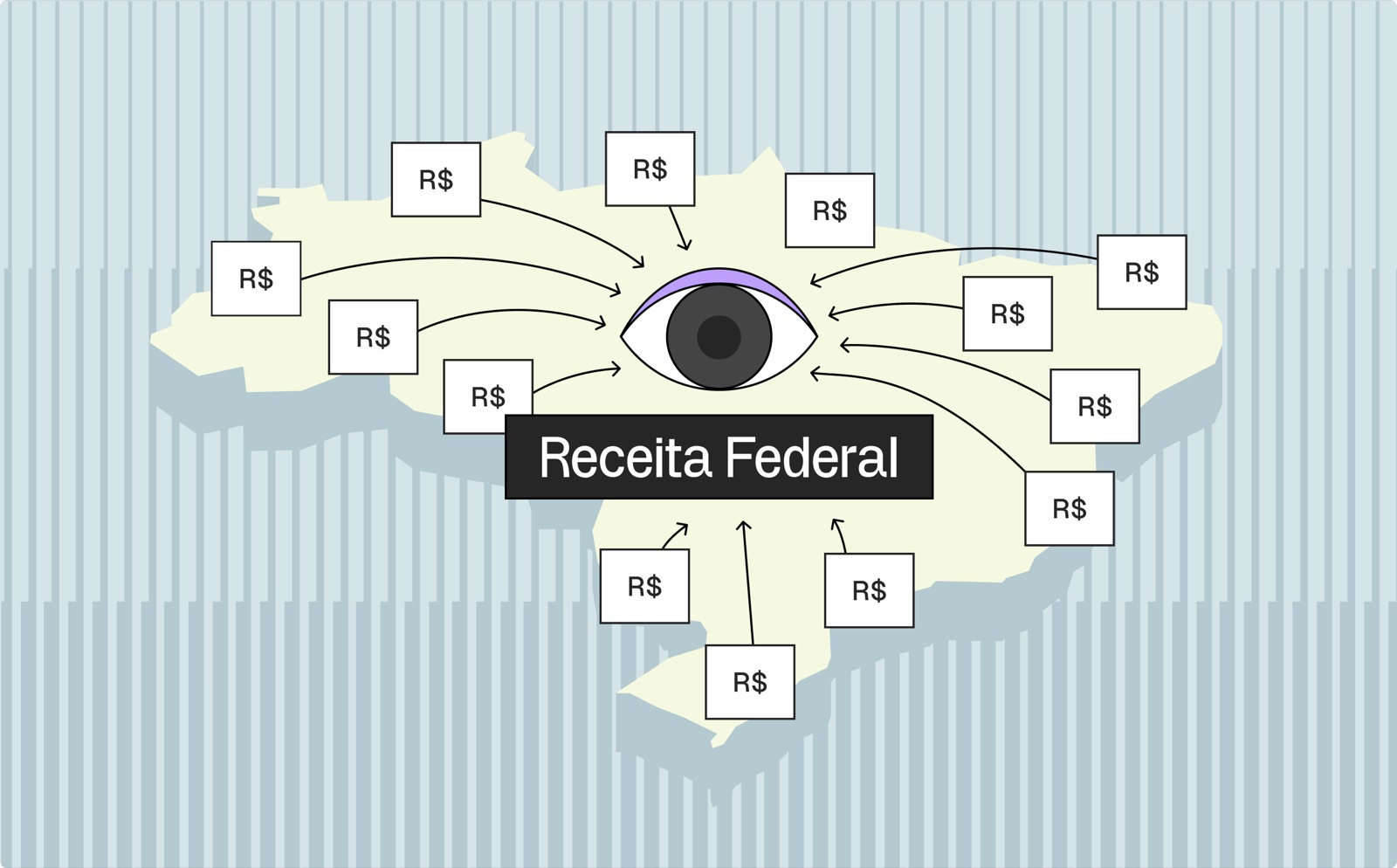
What is e-invoicing, and why does it exist?
E-invoicing is a government-mandated digital document that records every transaction in real time. In Brazil, fiscal documents are (i) issued, (ii) transmitted, and (iii) stored exclusively in XML format, authorised by the tax authority before the transaction counts.
It exists for three reasons:
- Tax control: every BRL collected is registered with the tax authority.
- Audit trail: an immutable XML record. No paper, no manual entry, no fraud.
- Automation: structured data enables automated tax calculation and reporting.
The key thing: the system is deterministic. It doesn’t negotiate — it reads structured data and fires rules. To issue an e-invoice at all, a company needs API credentials from the Prefeitura (services) or SEFAZ (products and telecom). No credentials, no invoice. No invoice, no sale.
The words you need
Seven terms and you can follow the rest:
| Term | What it means |
|---|---|
| NFS-e | Nota Fiscal de Serviços Eletrônica, the e-invoice for services (IT, software, fintech, consulting, among others). Legal basis: LC 116/2003, plus each municipality’s own rules. |
| NFCom | Nota Fiscal de Comunicação, the e-invoice for telecom (phone plans, internet, eSIM, data, among others). Telecom operators only, regulated by ANATEL. |
| NF-e | Nota Fiscal Eletrônica. For physical products. |
| ISS | Municipal services tax, 2%–5%. Attached to NFS-e. Every municipality sets its own rules. |
| ICMS | State-level tax on goods and telecom. Attached to NFCom. |
| CBS | The new federal VAT (LC 214/2025). Replaces PIS + COFINS. This is the one foreign digital sellers will owe from 2027. |
| IBS | The new state + municipal VAT. Replaces ICMS + ISS. |
NFS-e vs NFCom: which one describes your sale?
The two documents answer different questions. NFS-e describes which service was provided: per transaction, per customer, under municipal rules (São Paulo runs its own Nota Fiscal Paulistana at nfe.prefeitura.sp.gov.br). NFCom describes which line or connection was used, and in which period: monthly or per event, per subscriber, under state rules.
| NFS-e | NFCom | |
|---|---|---|
| Who uses it | All service companies | Telecom operators only (telcos, ISPs) |
| For what | IT, software, fintech, consulting | Phone plans, internet, cable TV, eSIM, data packages |
| Taxes | ISS (municipal, 2%–5%) + PIS/COFINS (federal, 3.65%–9.25%), now also IBS/CBS | ICMS (state) + PIS/COFINS, now also IBS/CBS |
| Regulated at | Municipal level (LC 116/2003) | State level (Lei 9.472/1997 + LC 87/1996) |
| Scope | Per transaction, per customer | Monthly or per event, per subscriber |
If you sell software subscriptions into Brazil, you’re in NFS-e territory. If you sell connectivity (an eSIM, a data package) you’re in NFCom territory, with ANATEL regulation on top. Either way, the document sits between your payment and your tax obligation: the invoice records the sale, the tax attaches to the invoice.
What changes in 2027?
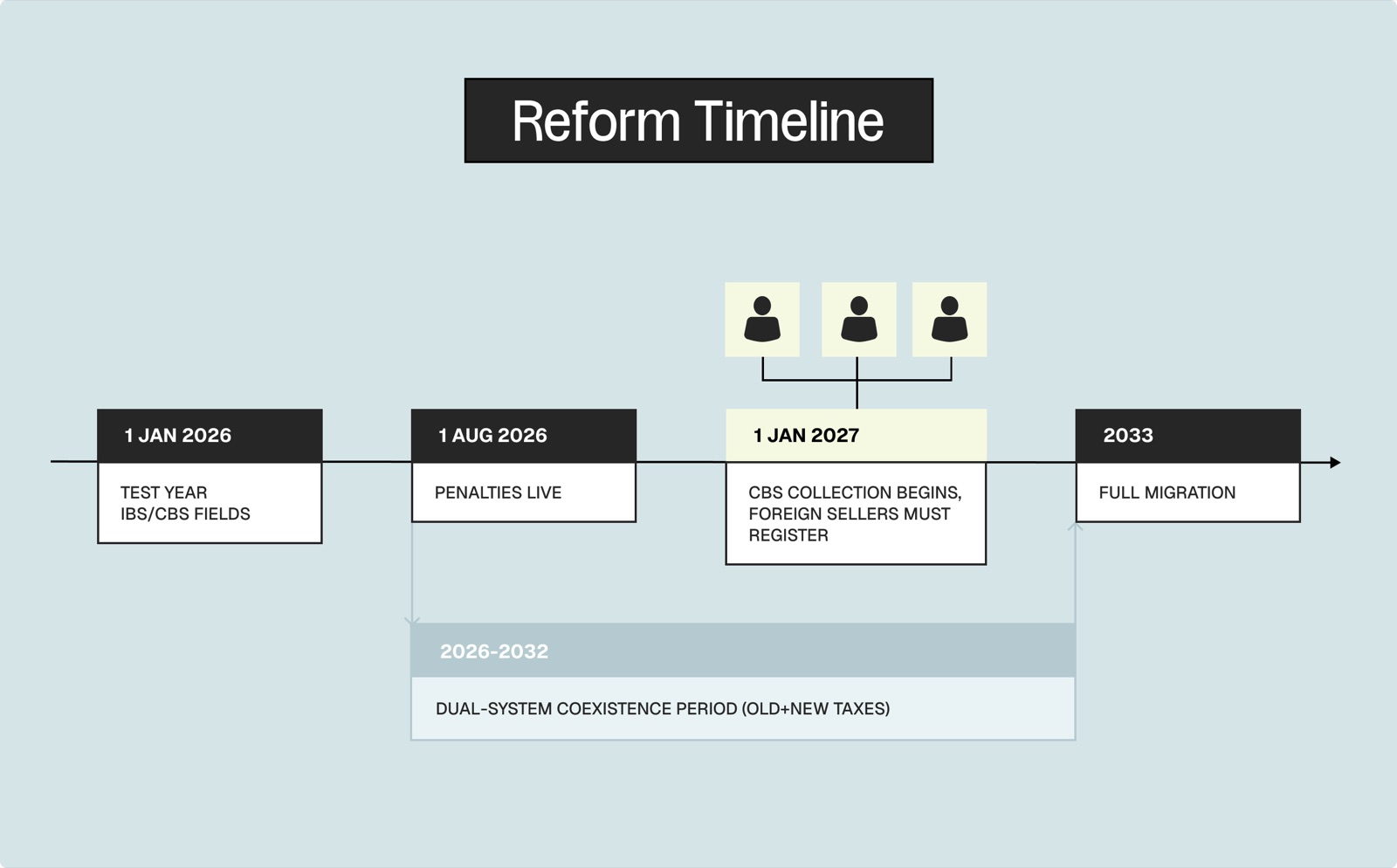
Why now? Complexity. Brazil runs one of the most fragmented tax systems in the world: a state tax, a municipal tax with thousands of local variations, and layered federal taxes, each with its own e-invoicing portal and XML layout. The reform (LC 214/2025) collapses it into a VAT system the rest of the world would recognise. The rollout is phased:
- 1 January 2026: the test year begins. E-invoices carry the new IBS/CBS fields; from 3 August 2026 a document without them is automatically rejected. NFS-e already has the fields built in.
- NFS-e Nacional, one XML standard for the whole country, managed by Receita Federal, replacing city-by-city portals and layouts. Today, municipalities either join the national portal directly or run as “conveniado” (like São Paulo), keeping their own portal but syncing to the national system. Not all municipalities have joined yet; the fiscal authority is pushing for full adoption before 2027.
- 2027: CBS collection begins. PIS (0.65%/1.65%) and COFINS (3%/7.6%) go away, replaced by CBS. Foreign companies selling digital services to Brazilian consumers must register for CBS and collect it at the point of sale.
- 2026–2032: both systems coexist. ICMS and ISS phase out as IBS phases in. Full migration completes by 2033.
What it means in practice: the foreign eSIM seller
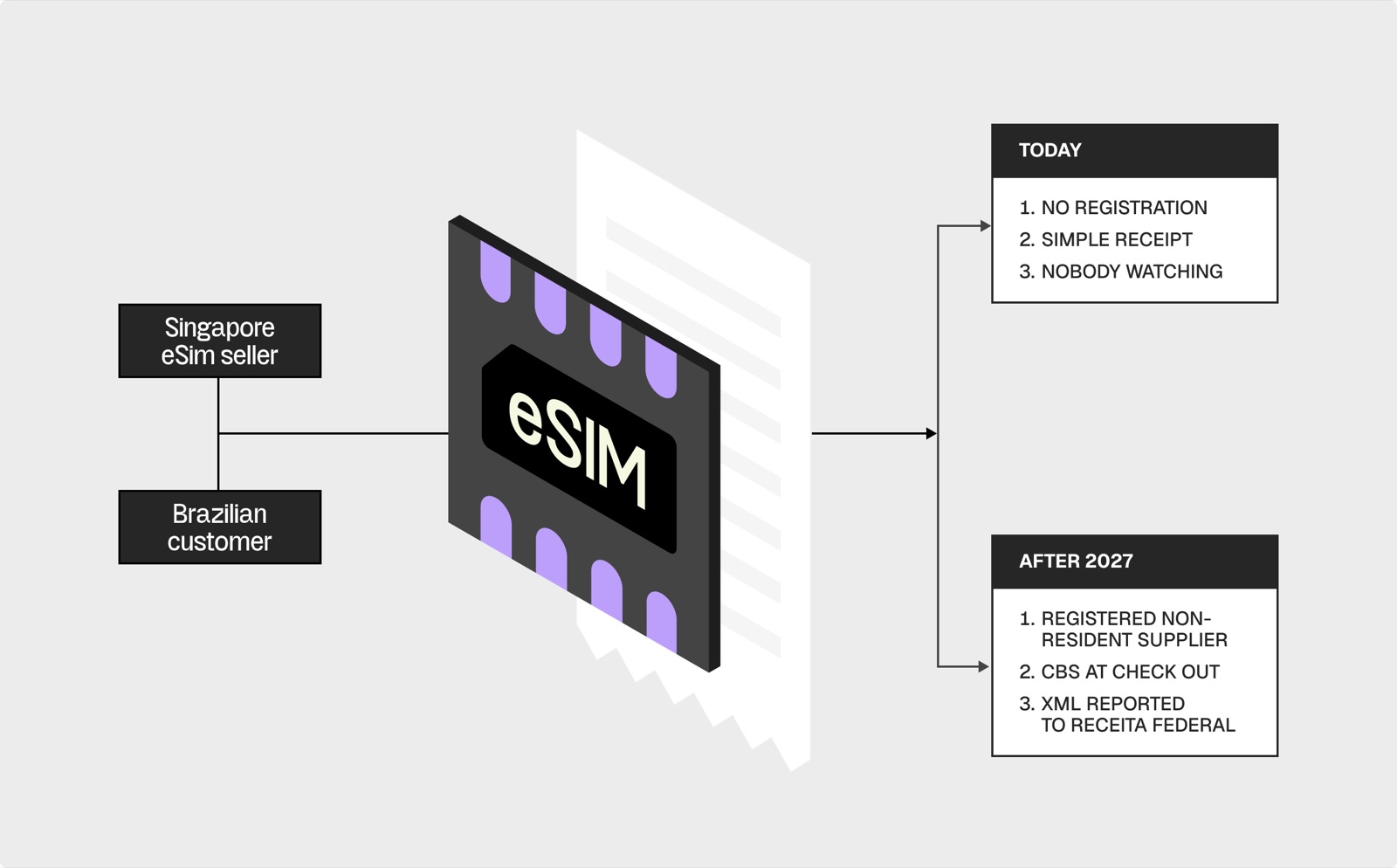
Take a foreign eSIM provider, headquartered in Singapore, selling travel data packages to Brazilian customers.
| Today | After 2027 | |
|---|---|---|
| Fiscal document | Simple receipt, no XML, no authorisation | CBS included and reported to Receita Federal |
| Registration | None, no Brazilian fiscal obligations | Registered as a non-resident supplier under the CBS regime |
| Tax collected at checkout | None | CBS, at the point of sale |
| Who’s watching | Nobody | Receita Federal, in real time |
And that’s just the consumer side. The B2B side is already painful today: a foreign vendor selling a $10K contract into Brazil can cost the Brazilian buyer $12K–$13.5K once 20–30% withholding (PIS/COFINS/ISS/IRRF) and the 3.5% IOF tax on the FX remittance stack up. The buyer either eats it or negotiates your price down to cover it. Selling into Brazil has never been just a tax question — it’s a payments question too, and the reform ties the two together at the checkout.
How should sellers prepare?
Strip away the acronyms and the reform does one thing: it pulls foreign sellers inside Brazil’s fiscal perimeter. “We’re not established in Brazil” stops being an answer.
That leaves two choices. Build it yourself: register as a non-resident supplier, get API credentials, issue authorised XML for every transaction, track which municipalities have joined NFS-e Nacional, run the 2026–2032 dual-tax transition, and stand up local payment collection on top. Or hand all of it to infrastructure that already runs it.
That second option is what Outpost does: we become the local seller in Brazil for you (what’s known as Merchant of Record). We take payment locally (PIX and cards, without the cross-border FX drag), we issue the fiscal documents, we register and collect the new CBS, and we carry the legal liability. If a filing is wrong, we pay the fine, not you. The old question was “which invoice format does Brazil want?” From 2027, the only one that matters is “who carries the risk?”
FAQ
What is NFS-e?
The Nota Fiscal de Serviços Eletrônica, Brazil’s mandatory e-invoice for services. Issued, transmitted, and stored in XML, authorised by the municipal tax authority (Prefeitura) before the transaction is valid. Legal basis: LC 116/2003, plus each municipality’s own regulation.
What’s the difference between NFS-e and NFCom?
NFS-e describes which service was provided (per transaction, per customer, municipal rules). NFCom describes which line or connection was used and in which period (per subscriber, state rules). It’s for telecom operators only, regulated by ANATEL.
Do foreign companies need to issue Brazilian e-invoices today?
No. A foreign company selling digital services from abroad has no Brazilian fiscal obligations today — a simple receipt is enough. That changes in 2027. It’s worth noting that the specific regulation for foreign companies selling into Brazil is still being defined.
What changes for foreign sellers in 2027?
Under tax reform LC 214/2025, foreign companies selling digital services to Brazilian consumers must register for CBS (the new federal VAT) and collect it at the point of sale, reported to Receita Federal.
What are CBS and IBS?
Brazil’s new VAT system. CBS is the federal VAT, replacing PIS and COFINS. IBS is the state + municipal VAT, replacing ICMS and ISS. The two systems coexist during a 2026–2032 transition, with full migration by 2033.
Want to sell into Brazil without building a tax department in São Paulo?
See how Outpost becomes the local seller of record in Brazil — taking payment locally, issuing the fiscal documents, registering and collecting the new CBS, and carrying the legal liability — so the 2027 reform lands as a setup task, not a scramble.
This article explains Brazil’s e-invoicing and tax reform for general information and isn’t legal or tax advice. Several rules — notably the specific CBS regime for foreign sellers — are still being finalised; confirm the current requirements before acting. For advice specific to your business, consult a qualified Brazilian tax professional.

