Your Brazilian champion says yes. Then the deal goes quiet in procurement.
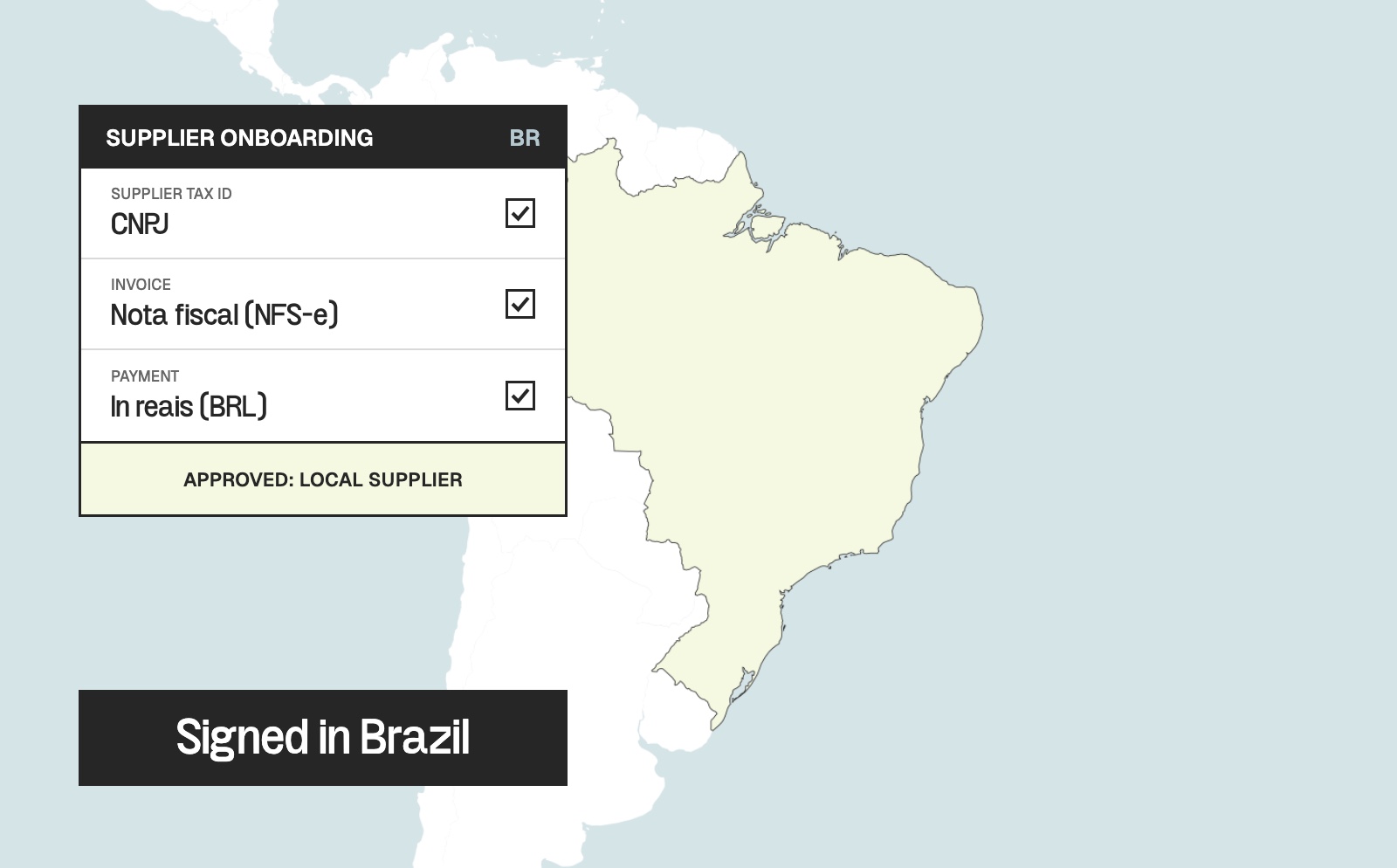
The reason is rarely price or product: Brazilian finance teams expect a local supplier with a Brazilian tax ID (CNPJ), a Brazilian invoice (nota fiscal) and payment in reais. A foreign supplier breaks all three.
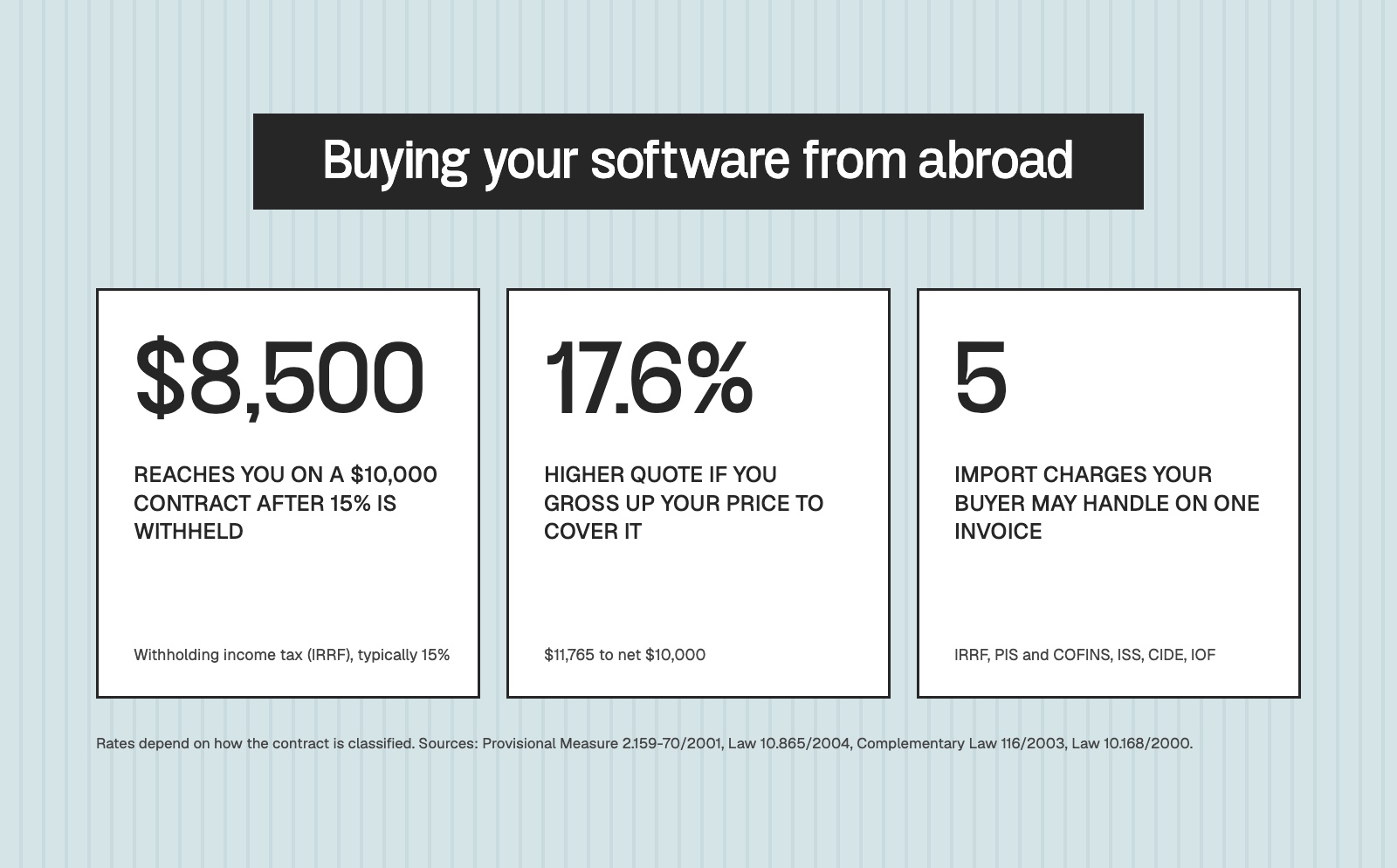
The cost shows up fast. On a $10,000 contract, your buyer typically withholds 15% before paying you, so $8,500 reaches your account.¹ Gross up your price to cover it, and your quote rises 17.6%. Add the other taxes on imported services. This can go even higher: $13,500 to $15,000.²
One US data and analytics company was losing Brazilian enterprise deals worth $300,000 to $400,000 each. With Outpost as its local seller, it now sells to enterprise buyers in Brazil. It has asked us to set up the same in more countries.³
Q4 deals close in weeks, and Brazil’s new tax rules apply to these deals from 1 January 2027. Both make this the quarter to fix it.
Why Brazilian procurement stalls foreign suppliers
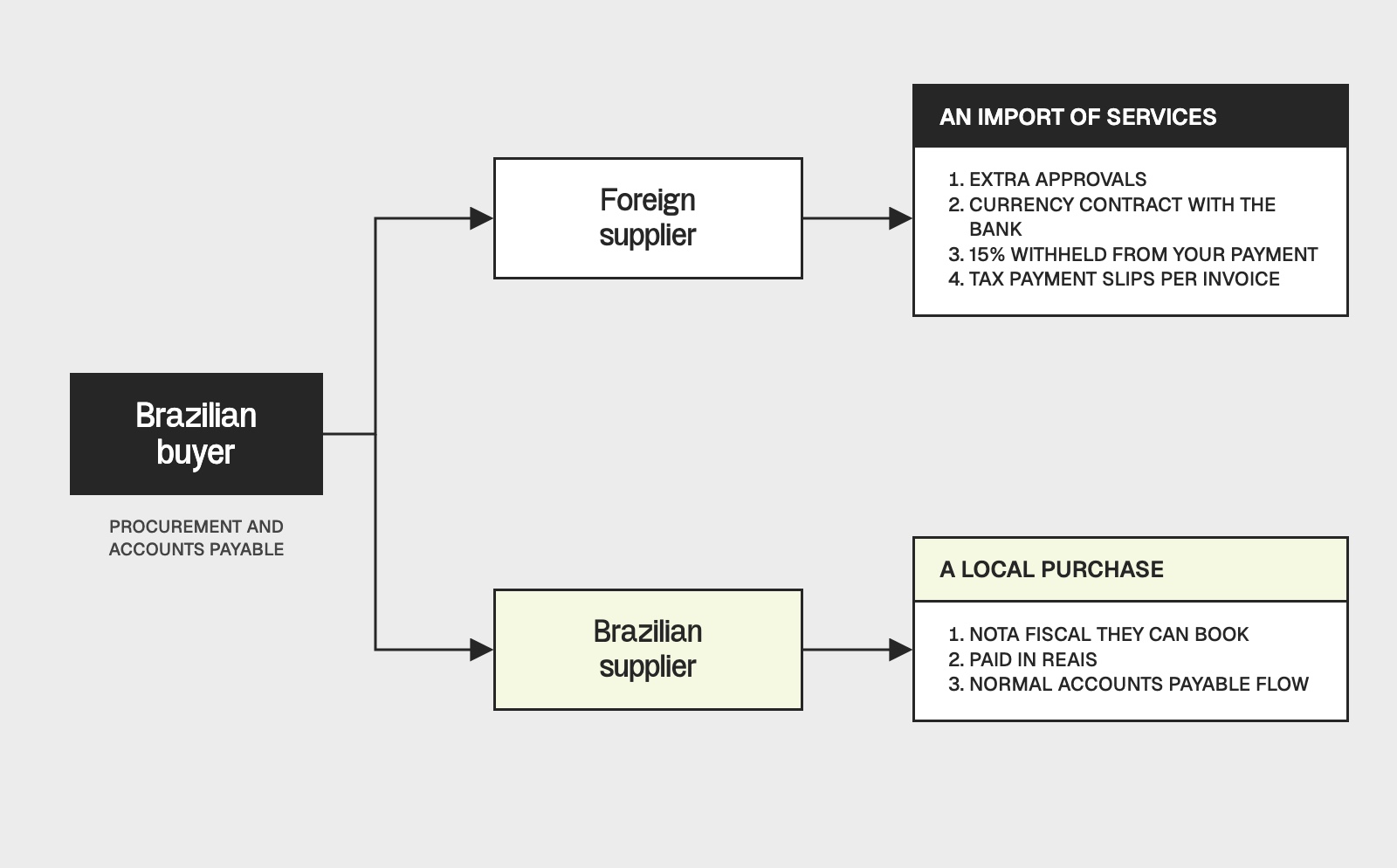
To a Brazilian finance team, buying software from abroad counts as an import of services. That changes who does the work.
A foreign supplier needs extra approvals. Procurement has to onboard a company with no CNPJ. That often means extra sign-offs and a currency contract with the bank.
A foreign invoice can’t be booked the normal way. Brazilian businesses book expenses against an electronic service invoice (NFS-e). Only a company registered in Brazil can issue one. Your commercial invoice pushes the purchase outside the normal accounts payable flow.
The buyer has to handle the tax. Depending on how the contract is classified, your buyer may need to:
- withhold income tax (IRRF) from your payment, typically 15%
- pay two federal contributions on the import, PIS and COFINS, at 1.65% and 7.6%
- pay the municipal service tax (ISS), at 2% to 5%
- pay CIDE at 10% where the service counts as technical services or royalties
- pay IOF on the currency conversion
Each one adds a tax payment slip and paperwork to each invoice. None of it appears on your invoice, so it comes back to you as a discount request.
2027 adds a new layer. From 1 January 2027, the new federal tax CBS replaces PIS and COFINS. Your buyer generally still owes it on an import. Under the new law, the foreign supplier is also jointly liable for that tax and has to register, though the operating rules aren’t published yet.⁴
There’s real demand in Brazil, and the contract set-up is what’s holding it back.
How to close more Brazilian enterprise deals
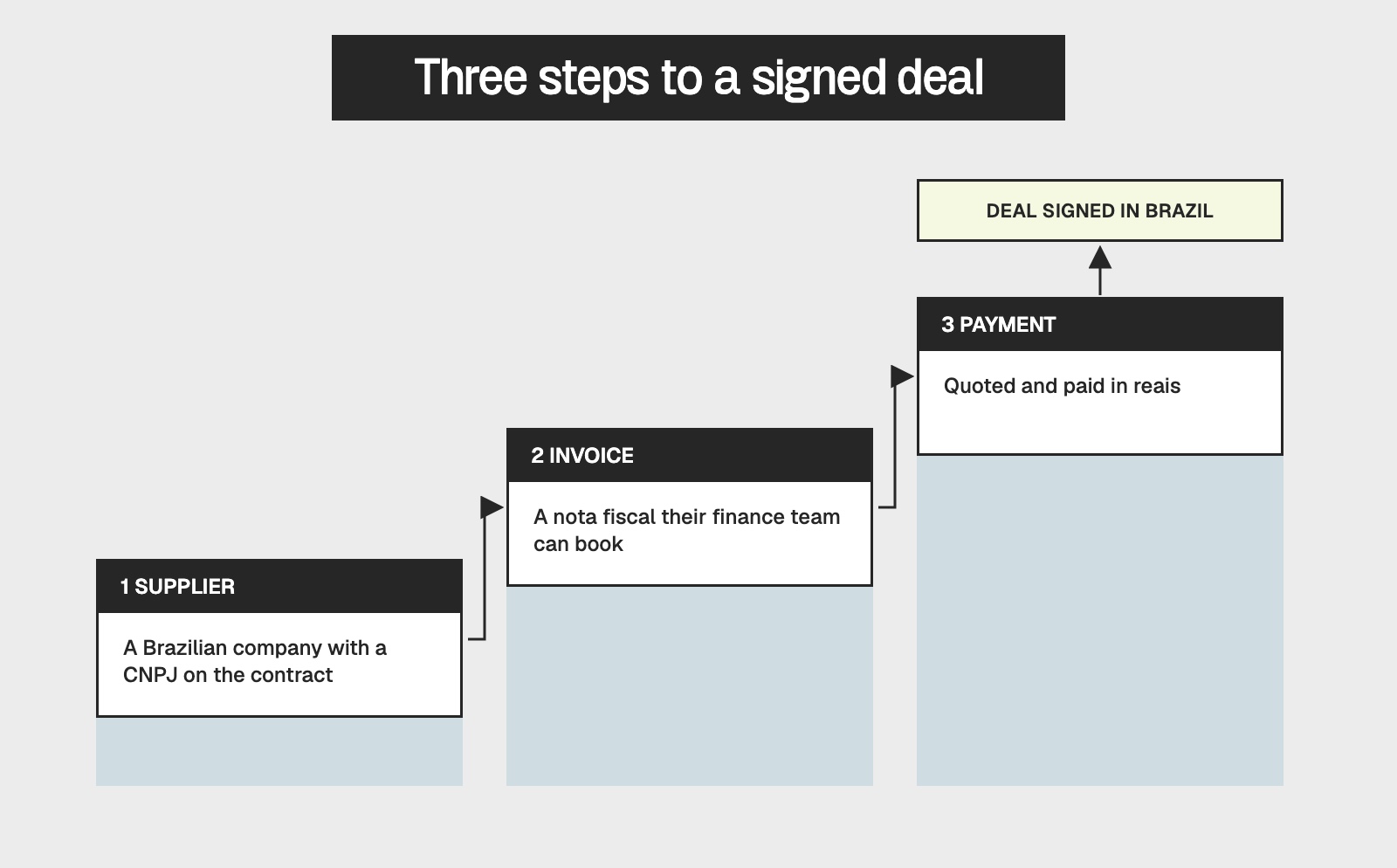
1. Put a Brazilian supplier on the contract
Procurement moves faster when your company looks like the local suppliers they already onboard. That means a Brazilian company with a CNPJ on the contract. Ask your champion early what the vendor form needs, before the deal reaches finance.
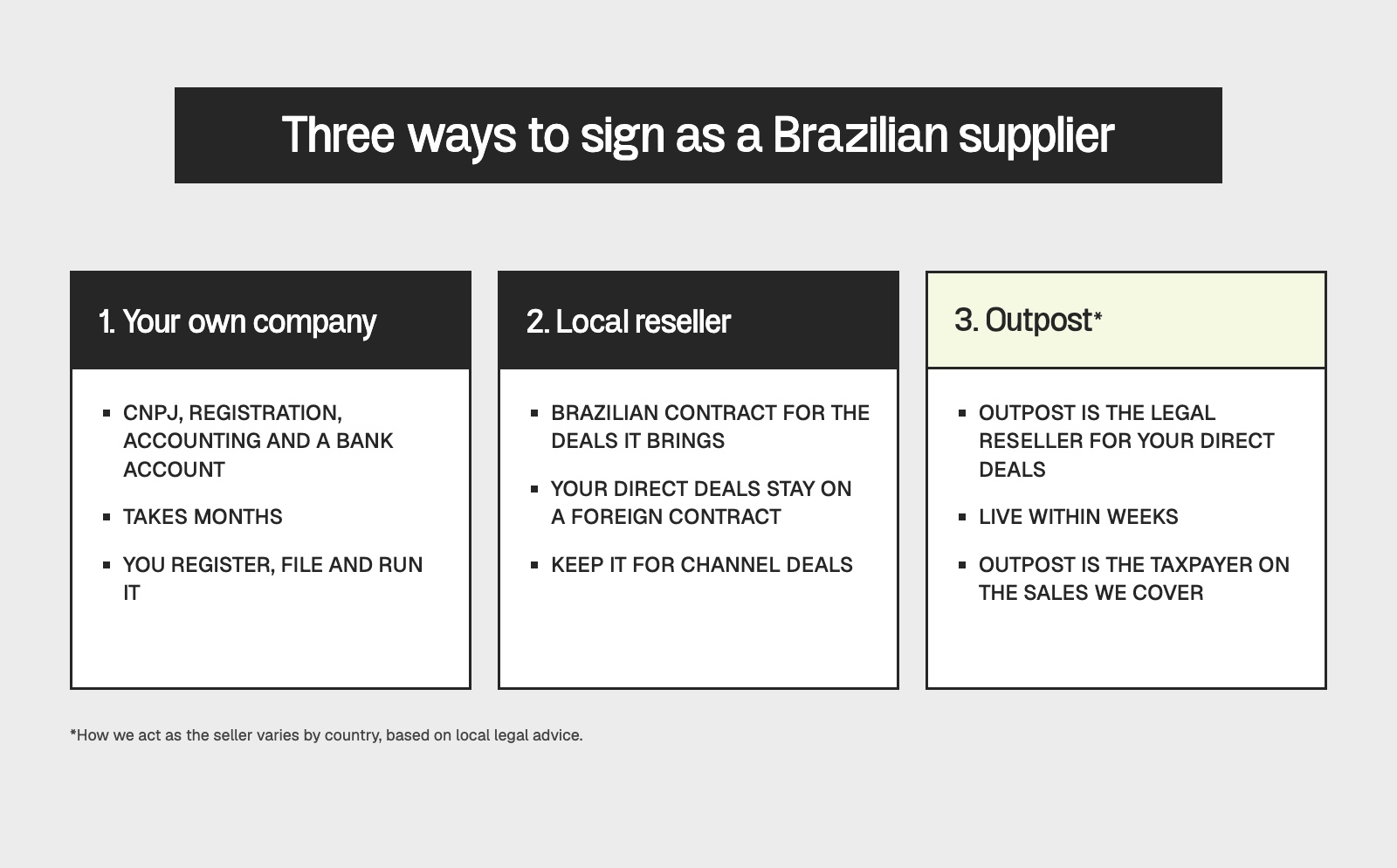
There are three ways to get a Brazilian name on the paper:
- Open your own Brazilian company. You need a CNPJ, a municipal registration, local accounting and a bank account. It takes months, and local sales staff can create a taxable presence in Brazil. Many large software companies have a Brazilian company that only does sales promotion and doesn’t sign customer contracts.
- Sell through a local reseller. Resellers already give some buyers a Brazilian contract and invoice, and they work well for the deals they bring in. The deals your own team closes directly still go out on a foreign contract.
- Use a legal reseller for your direct deals. Outpost’s Brazilian company is already registered, so you can start within weeks. You supply the software to Outpost, and Outpost resells it to your buyer through an addendum to your existing agreement. You keep the customer relationship and the pricing.
2. Give their finance team an invoice they can book
A Brazilian accounts payable team books expenses against an NFS-e. Find out early which fiscal data they need on it, such as their CNPJ and the tax breakdown. If the invoice can’t go through their normal flow, approval slows down.
Be open about the tax. A local supplier’s invoice still carries Brazilian tax, but a business on the regular regime can deduct most of it from what it owes.⁵ Raise it in your first call with their finance team.
Plan for 2027 too. From 1 January, these invoices include the new CBS and IBS fields. When Outpost is the seller, we issue the NFS-e for each sale and handle that change. We’re the taxpayer on the sales we cover. If we get a filing wrong, we pay the fine.
3. Let them pay you like a local supplier
Quote in reais. A price in dollars means the buyer has to arrange a currency contract with their bank and take on the exchange risk. Accept the ways Brazilian businesses already pay, such as bank transfer and Pix.
Settle withholding in the contract before signature. Either the buyer grosses up the payment, or they deduct the 15% and you chase a tax receipt. Leave it open and it comes back as a short payment or a discount request.
Or remove the question altogether. When your buyer pays a local supplier, there’s no foreign invoice to withhold from. They pay our Brazilian company in reais, and we pay you for those sales in the currency you choose.
That doesn’t make the tax go away for you, though. Money from your Brazilian sales is still taxed when it’s sent abroad, whoever sends it. Some other legal resellers build that tax into their fee and don’t mention it, and you only find out by working backwards from what reaches your account. We put our fee and the tax in the contract as separate lines, for each market, before you sign.
Questions we hear from software companies
Do we need a Brazilian company to be compliant?
No. Nothing in Brazilian law says you have to open a company there to sell software. With Outpost as the legal reseller, your buyer gets a Brazilian supplier and a Brazilian invoice. Our Brazilian company is already registered, and it issues the invoice and pays the tax on the sales we cover. There’s still tax on what we pay you, though, and you’ll see the rate in the contract before you sign.
Who issues the Brazilian invoice, and what’s still ours?
Only a company registered in Brazil can issue a Brazilian service invoice. With Outpost, our Brazilian company issues it for each sale. You keep your pricing and your customer relationship. On a business contract, it is an addendum to the agreement you already have.
Close your Brazilian deals this quarter
Tell us which deals are stuck in Brazilian procurement. We’ll show you how to sign them with a Brazilian supplier on the contract, a nota fiscal and payment in reais.
How we act as the seller varies by country, based on local legal advice.
Sources
1. Withholding income tax (IRRF) on payments abroad, typically 15% (Provisional Measure 2.159-70/2001, art. 3). The rate depends on how the contract is classified and on any tax treaty.
2. Outpost estimate on a $10,000 contract with the price grossed up for withholding, before any PIS and COFINS credit: IRRF, PIS and COFINS on imports (Law 10.865/2004), ISS at 2% to 5% (Complementary Law 116/2003), CIDE where it applies (Law 10.168/2000) and IOF at 3.5% (Decree 12.499/2025). Actual cost depends on the contract.
3. Anonymised Outpost customer.
4. Complementary Law 214/2025, art. 64 §5 V and VIII, and art. 21 §2.
5. Complementary Law 214/2025, art. 47.

