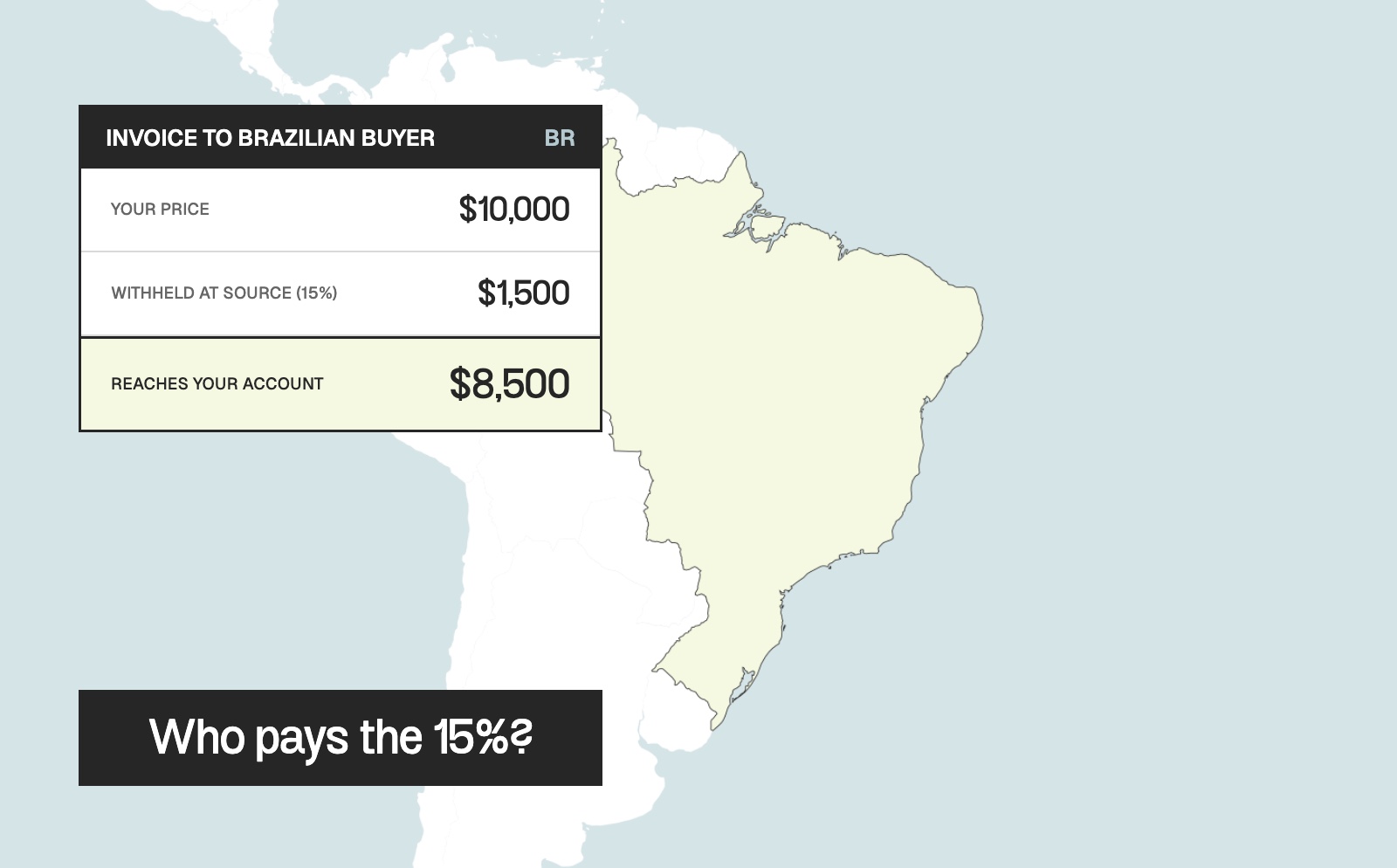
You quote a Brazilian customer $10,000. Their finance team says they can send $8,500.
The gap is withholding income tax. Brazil taxes software and services bought from abroad at source, typically at 15%.¹ The buyer takes it from your payment and pays it to the tax office.
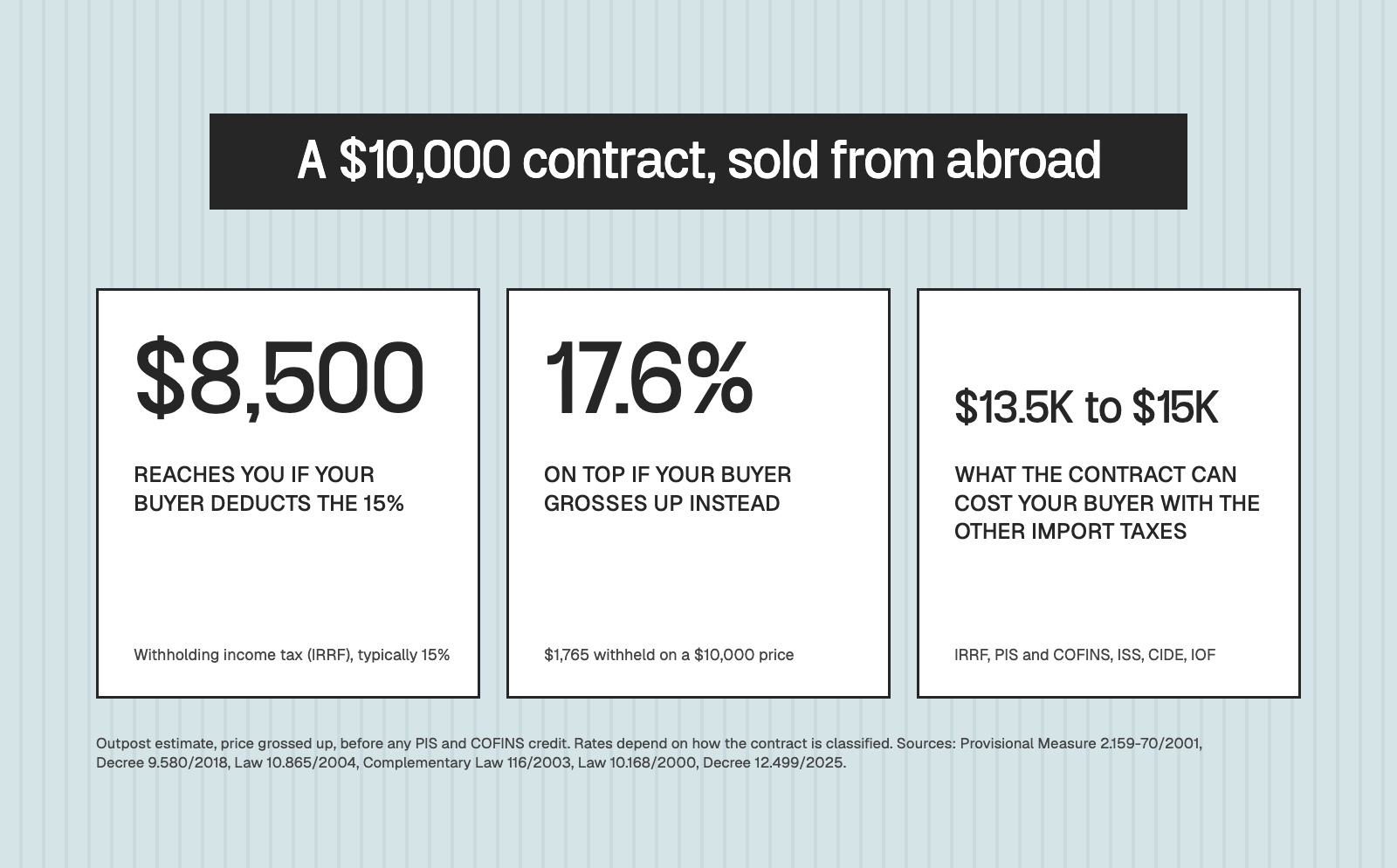
Someone pays it, and the contract decides who. Under a gross-up, your buyer pays it on top and their cost rises 17.6%. Under a deduction, you receive 15% less. Add the other taxes on imported services, and a $10,000 contract can cost your buyer $13,500 to $15,000.²
Year-end deals are closing now, and Brazil’s new tax rules apply to them from 1 January 2027, even if signed the year before. Both make this the quarter to settle it in your contracts.
How withholding tax works on software sold to Brazil
To a Brazilian finance team, software bought from a foreign company is an import of services. The law makes the Brazilian payer responsible for the tax.
The buyer withholds before paying you. The standard rate is 15%. It rises to 25% if you’re based in a country Brazil lists as low-tax.³ A tax treaty can lower it. The US has no income tax treaty with Brazil.
How the contract is classified changes what your buyer pays. A software licence is usually treated as a royalty. Support, implementation and cloud subscriptions (SaaS) are often treated as technical services. Both are typically withheld at 15%, but the label decides which other taxes apply.
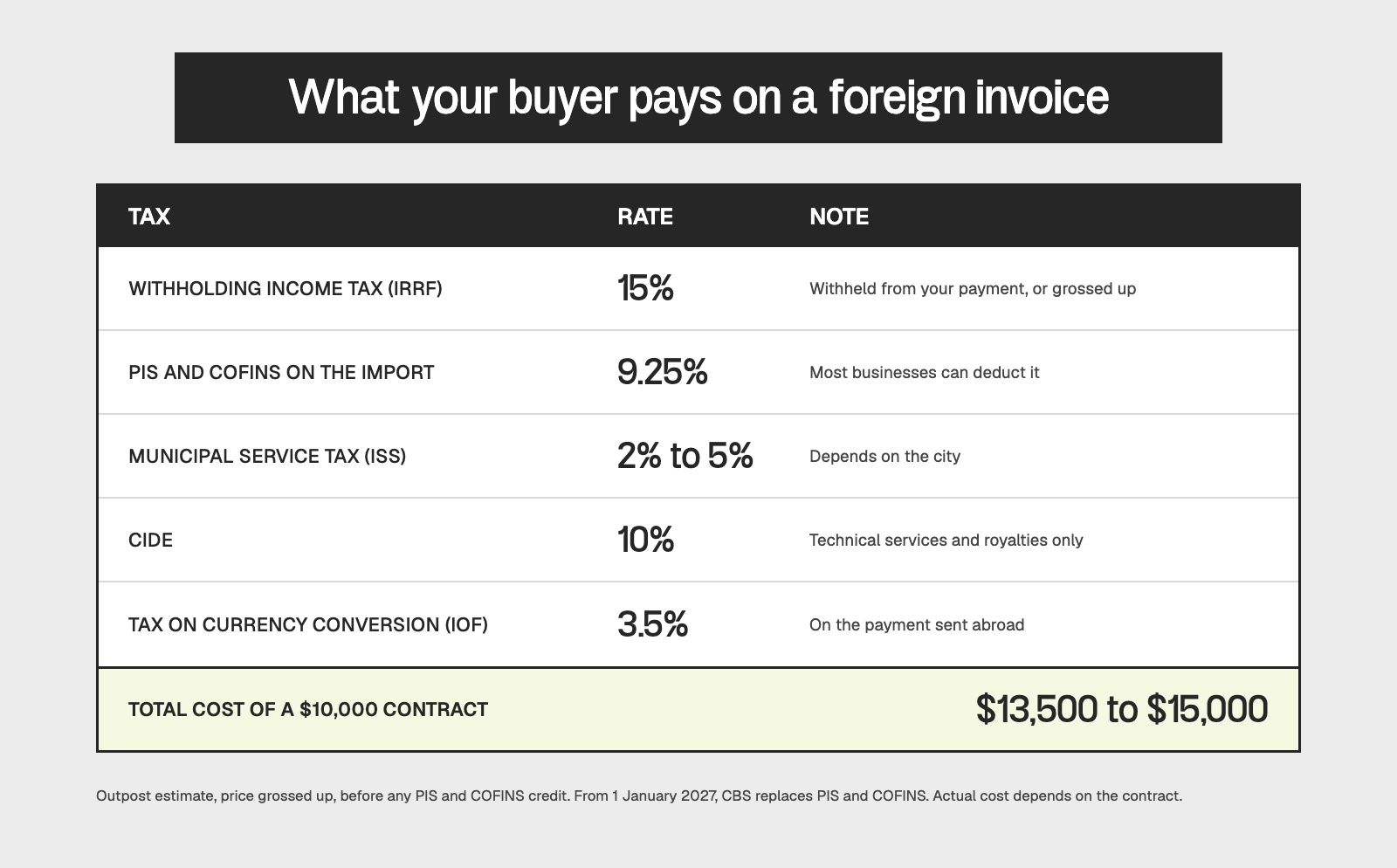
Other taxes add to it. Your buyer pays them, from the same budget as your invoice:
- two federal contributions on the import, PIS and COFINS, at 1.65% and 7.6%⁴
- the municipal service tax (ISS), at 2% to 5%
- a federal contribution on technology payments abroad (CIDE), at 10% on technical services and royalties. A licence to use software is outside CIDE unless it transfers the technology.⁵
- Brazil’s tax on foreign currency transactions (IOF)
Brazil’s Supreme Court upheld CIDE in August 2025. It confirmed the tax reaches payments abroad beyond technology transfer, including technical services.⁶
From 2027, a new federal tax (CBS) replaces PIS and COFINS. Your buyer generally still owes it on an import. Withholding income tax stays as it is.⁷
Because none of this appears on your invoice, it comes back to you as a request for a discount.
Gross-up or deduct: what each route does to your price
Gross-up: the buyer pays the tax on top
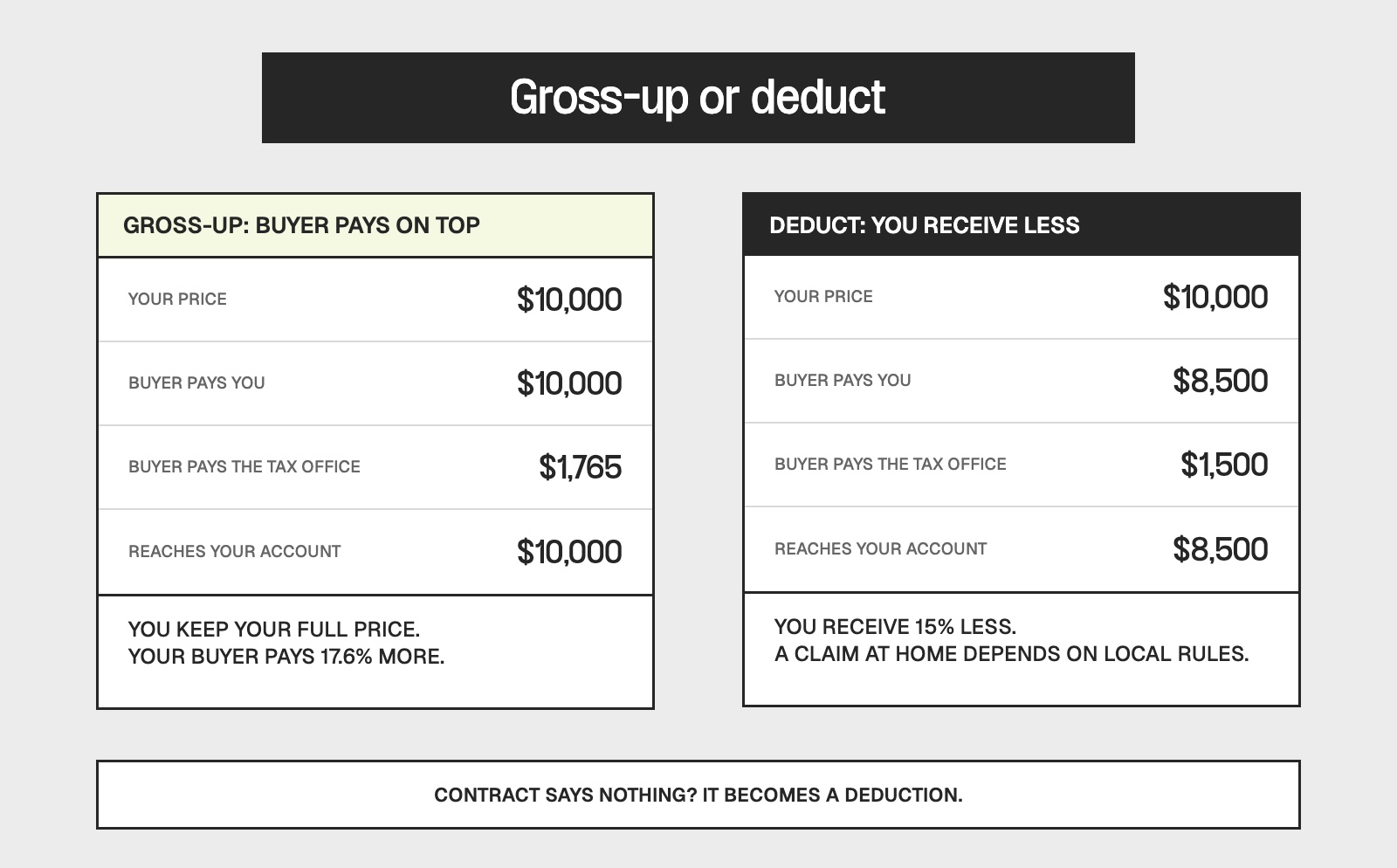
Your contract says your prices exclude Brazilian withholding tax. The buyer pays you the full $10,000 and pays the withholding to the tax office.
The tax isn’t 15% of your price. Brazilian law treats what you receive as the net amount and rebuilds the gross from it.⁸ On a $10,000 price, the withholding is $1,765, or 17.6% on top.
What it means for you:
- you keep your full price
- your buyer pays 17.6% more, making local suppliers cheaper by comparison
Deduct: you receive less
The contract is silent, or says your price includes all taxes. The buyer withholds 15% and sends you $8,500.
What it means for you:
- you receive 15% less on each invoice
- claiming it back at home needs the buyer’s proof of payment, and your home rules must allow it
If you can’t use the full credit, the 15% becomes a cost of selling in Brazil.
When the contract says nothing
Because the buyer is legally required to withhold, a silent contract becomes a deduction. It shows up as a short payment, an invoice dispute or a discount request at renewal. Either route leaves the withholding as part of the deal, paid by you or by your buyer.
How to keep your full price in Brazil
1. A tax clause decides who pays
A withholding clause in your order form settles who pays the 15%. If your prices exclude it, your price is safe, but your buyer pays 17.6% more. If they include it, you receive 15% less and need the buyer’s tax receipt (DARF) to claim it at home.
Splitting the order into licence, support and SaaS changes which other taxes apply. Your buyer still withholds on every part, typically at 15%.
2. Put a Brazilian supplier on the contract
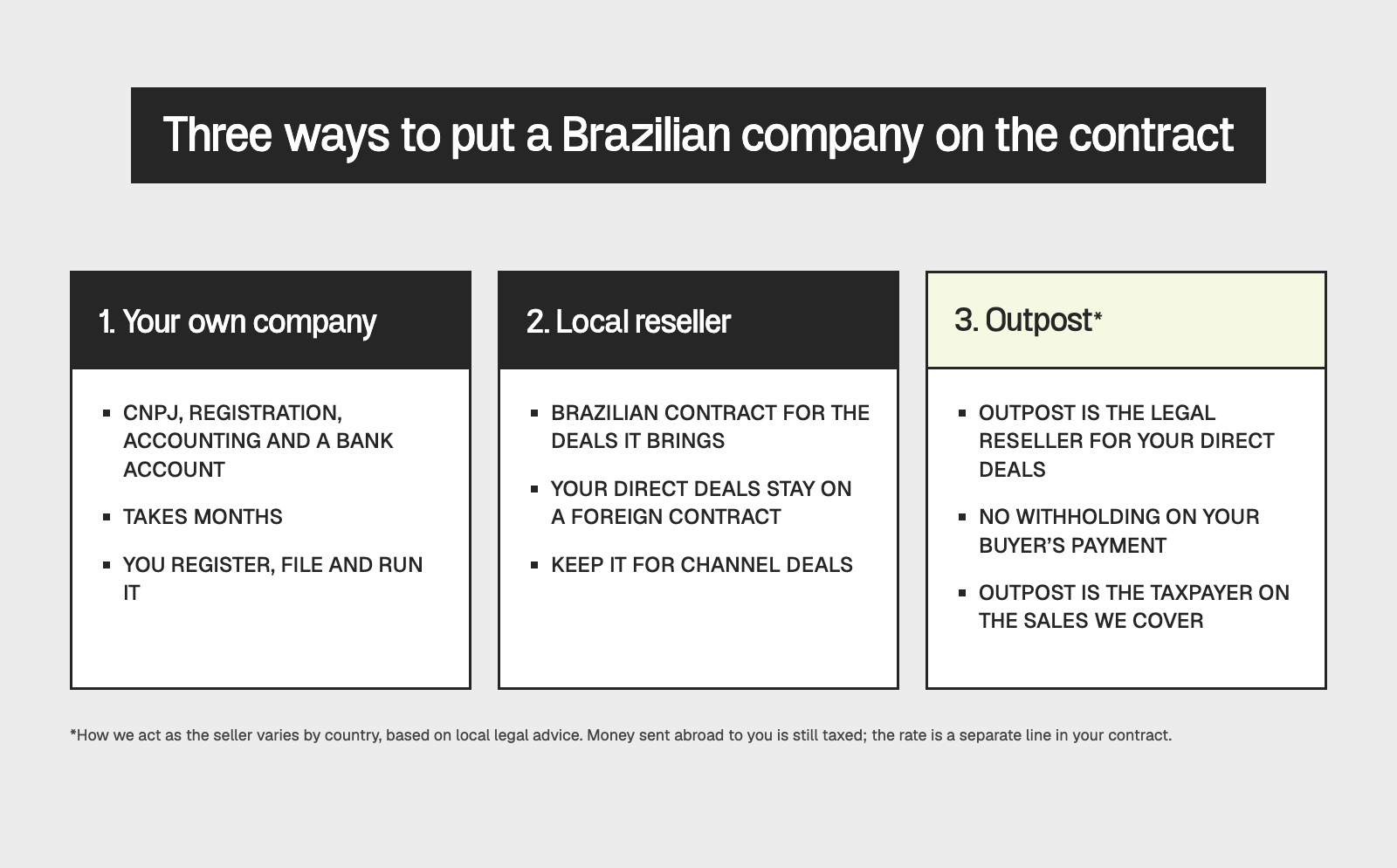
When your buyer pays a Brazilian company, there’s no foreign payment to withhold from. They get a Brazilian invoice (nota fiscal) and pay in BRL, by bank transfer or Pix. A business on the regular regime can deduct most of the Brazilian tax on it.
Opening your own Brazilian company takes months, and you run its accounting and bank account yourself. A local reseller covers only the deals it brings in, and the deals your own team closes stay on a foreign contract.
Outpost resells the deals your own team closes. Our Brazilian company is already registered. Your contract with the buyer gets an addendum naming us as the seller, and you keep the customer relationship and the pricing. We issue the nota fiscal and we’re the taxpayer on the sales we cover. If the tax authorities knock, they knock at our door.
We pay you for those sales in the currency you choose. Money from your Brazilian sales is still taxed when it’s sent abroad, whoever sends it. Some legal resellers fold that tax into their fee without saying so. We show our fee and the tax as separate lines in the contract before you sign.
Questions we hear from software companies
What does our Brazilian customer pay on top of our invoice?
On a foreign invoice, your buyer typically pays 15% withholding income tax. Add PIS and COFINS on the import, ISS and IOF. CIDE applies too if the contract counts as technical services, or as a licence that transfers the technology. With the price grossed up, a $10,000 contract can cost them $13,500 to $15,000.² A business on the regular regime can deduct the PIS and COFINS from what it owes. The rest stays a cost.
Can we claim the withheld 15% back?
Sometimes, at home. You need the buyer’s proof that the tax was paid. Whether it counts against your own tax depends on your home country’s rules and any treaty with Brazil. Check with your tax adviser before you build it into your pricing.
Does a legal reseller remove withholding tax completely?
It removes it from your buyer’s payment, because they pay a Brazilian supplier. Money sent abroad to you is still taxed. You’ll see that rate in the contract, as its own line, before you sign.
Keep your full price on Brazilian deals
Tell us which Brazilian deals are stuck on withholding tax. We’ll show you how to sign them with a Brazilian supplier, a fiscal document and payment in BRL.
Talk to usHow we act as the seller varies by country, based on local legal advice.
Sources
1. Withholding income tax (IRRF) on payments abroad, typically 15% (Provisional Measure 2.159-70/2001, art. 3). The rate depends on how the contract is classified and on any tax treaty.
2. Outpost estimate on a $10,000 contract with the price grossed up for withholding, before any PIS and COFINS credit: IRRF, PIS and COFINS on imports (Law 10.865/2004), ISS at 2% to 5% (Complementary Law 116/2003), CIDE where it applies (Law 10.168/2000) and IOF at 3.5% (Decree 12.499/2025). Actual cost depends on the contract.
3. Law 9.779/1999, art. 8.
4. Law 10.865/2004.
5. Law 10.168/2000, art. 2 §1-A, added by Law 11.452/2007.
6. Supreme Federal Court (STF), RE 928.943, Theme 914, decided 13 August 2025.
7. Complementary Law 214/2025, art. 64 §5.
8. Income Tax Regulation (Decree 9.580/2018), art. 786.

